Every year, it seems like trees and flowers are tricked into budding early by a few days of unseasonably warm weather. We had a warm spell about three weeks ago followed by a week of on and off again snow. Walking out to feed the birds, I noticed my lilacs were getting ready to burst into blossom. "No you fools! Not yet!" I cried.
Lilacs are a hardy flowering bush, beloved of the early pioneers probably because few other flowers grew well in our desert climate and sandy soil. You can find their clusters of purple flowers and delicate scent in almost all the older yards in Nevada. If there's just a little water, you'll still find them flourishing near anywhere the pioneers settled.
Peavine
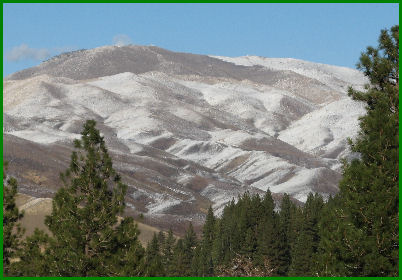
The tradition in the valley is you don't plant until all the snow is off Peavine Mountain northwest of Reno. Peavine only climbs to an elevation of about 8, 000 feet, much lower than the summits of the Sierra Nevadas to the West which reach 10,000 to 11,000 feet. Its lower elevation is a good barometer of how spring is shaping up. Trust me, there is still a lot of snow up on Peavine, no matter how warm it feels here in the valley. My poor lilacs, however, don't seem to know or care about this particular piece of local horticultural wisdom.
Out of the corner my eye I saw it streaking down out the slate blue sky.I was not even sure what it was until I saw it thunk heavily on a dove sitting quietly near one of my birdfeeders.It was a red tailed hawk.Without even thinking, I rushed to the back door and yelled, "You hawk!Leave my dove alone!"The hawk looked up startled to be yelled at and took off.The dove got up, shook itself, and seemed none the worse for its near-death experience.
I felt sheepish afterwards.Lord knows, hawks have to eat too, and I have no idea how the dove felt about being described as "my" dove.What I hadn't realized is those gentle doves that hang around my backyard had gotten to me.I kind of felt sorry for them.The little brown wrens bob all over the place frantically, the pigeons muscle out smaller birds, the blue jays stop by screaming loudly to get their fair share, and if I put out peanut butter suet, a type of blackbird stops by in flocks to devour it within half a day, but the poor dove will just sit and wait until everyone else is done and then quietly munch on whatever seeds are left.If I get behind in filling the birdfeeder, the wrens go looking elsewhere, the blue jays and the rest are long gone, but not the doves.They'll hunker down underneath the birdfeeders and kind of look at my back window with mournful eyes.Sometimes they'll get up on the roof, and I'll hear their sad cries reminding me I've neglected them.It may take me awhile to get to filling the birdfeeders, but still, they stay, waiting patiently.
Isn't it remarkable that of all the birds God could've chosen to symbolize the Spirit, he chose a dove in Matthew 3?
And when Jesus had been baptized, just as he came up from the water, suddenly the heavens were opened to him and he saw the Spirit of God descending like a dove and alighting on him.
I sometimes get the impression that a lot of Christians would prefer to see the Spirit as a hawk – diving, attacking, strong.Instead, God chose the dove, the gentlest of creatures.If I am to let the Spirit do its work in my life, perhaps I need to stop looking for dramatic changes radiating power and drama, and instead accept the gentleness, the quiet, the faithfulness of the dove.
Having been retired from teaching about nine months, I admit I miss joking and talking with the kids. What I don't miss, however, is my stomach clenching when I would see the weather forecast on the evening news. If there was rain or snow predicted, it meant a terrible forty-five minute commute, and a rough day. Today, it's snowing, school's delayed, and you just know we would have to keep the kids in at lunch and recess, effectively cancelling any private or quiet time. I would be condemned to sitting in a box all day surrounded by the aromas and noise of wet, hyper eleven-year-olds. So, I woke up this morning, saw the blizzard conditions outside, and said to myself, "Who's a clever duck? I'm a clever duck!" I get to relax at home with my second cup of coffee (OK, my seventh cup of coffee, but who's counting?), and enjoy my birds in the winter wonderland outside my window! I'm feeling terribly, terribly clever.
There's something special about a Nevada sunset. The sheer lack of humidity in our desert climate seems to make the edges of the clouds sharper and the colors more vibrant. Ours are not the sunsets that fade into gray because of the reflected grime of a megalopolis, nor are they the gentle watercolor sunsets of Florida or the Hawaiian Islands. Nevada sunsets are defined and shot through with slashes of gold, fiery orange, deep red, and purple. They're the kind of sunsets you can ride off into at the end of the movie.
Praise the Lord from the earth… hail, snow and frost, stormy wind fulfilling his command! – Psalm 148:7, 8
This morning, we awoke to find the valley shrouded in icy gray fog. Every pine tree, fencepost, and skeletal vine was covered in what we in the West call pogonip. Pogonip is our word for the rare ice fog that produces dramatic and beautiful spiked frost covering everything. It's almost like overnight, snowflakes were magnified a thousand times and then attached to everything, and now with your naked eye you can actually see their intricate crystalline structures. Conditions have to be just right for pogonip to form: temperatures have to be below freezing, and humidity has to be at about 100%, which is a rare occurrence in the high desert. It's a spectacular, yet eerie sight.
The first Americans found it difficult to see any beauty in pogonip. The word comes from a Shoshone word meaning "white death" or "frozen death". The Washoe Indians who summered at Lake Tahoe, but wisely wintered here in the valley where it's usually warmer, often saw weaker or older persons in their tribe carried off by respiratory diseases during such extreme weather.
Still, pogonip's delicate white splendor remains, and this morning's rush-hour seems somehow hushed… muted, as though even busy commuters recognize they are in the presence of some of God's finer handiwork.
“…he made a decree for the rain, and a way for the thunderbolt;” – Job 28:26
Most of my free time today was spent working in my backyard repairing a part of my sprinkler system. Deep in mud and rock, I was finally getting to the end of it, when the wind picked up. I didn’t think much of it; I was determined to finish the job today. Dark clouds moved in. I stopped for some refreshing iced tea made of black tea leaves combined with mint. I took my first sip, and the power went out – I heard distant thunder. I figured the power would come back on eventually; I wasn't worried. You can always tell when a storm is coming because the wind carries the distinct warm smell of wet sagebrush. I figured I had a little time yet, so undeterred, I went back to work. It began to rain. Now, rain in the desert isn’t like rain elsewhere; it usually stops after a few minutes hardly dampening the ground. I was getting wet, but it actually felt good after the long hot day in the sun. Suddenly, the thunder was much closer, and the rain began to come down hard. Am I one to be scared by a little thunder and rain, even the occasional flash of lightning? Not me. I’m made of tough Nevadan desert with a cowboy mentality to match. At least I wasn’t afraid… until the hail began. I gathered up everything and ran for the house. Part of having a tough Nevada cowboy mentality is also knowing when to get out of the way before you get toasted like a cheap marshmallow by a stray bolt of lightning.
We knew our first serious storm was coming, but I do not think anyone expected the punch we got. In my area in the foothills, I would estimate we received eighteen inches of snow. School was cancelled, so I am very glad I did not have to drive in these conditions today, although living in the mountains, I am kind of blasé about chaining up the car if it is necessary. I spent most of the day shoveling. The day off was fun (I know the kids are thrilled), but we will probably be grumbling when they tack on that extra make-up day in June. The birds are well fed and cluster around my trees and feeders keeping warm. Casey, one of my cats, kept a close eye on them. They were so thick in the one tree that it looked like I had my own Christmas tree decorated with birds for ornaments. This is the beginning of our annual snowpack that fills our rivers and reservoirs to supply our water the rest of the year, so let it snow! Let It Snow! Let It Snow!
Look at the birds of the air; they neither sow nor reap nor gather into barns, and yet your heavenly Father feeds them. - Matthew 6:26
I feed the birds in my backyard. Year-round, they get seed, but in the winter, they also get their favorite: peanut butter suet. When I go out to refill their feeders, I like to pretend I'm St. Francis. Of course, over the years, I think I have blurred the historical St. Francis and Disney’s Snow White. I have these images of St. Francis sitting at the wishing well, singing, and the little birds land on his outstretched finger and sing with him. That has never happened for me. I thought eventually the birds would get used to me, but whenever I come out, they scatter in panic as if to say, "Aaah! The monster comes!” They never seem to make the connection that I bring them food, and so I talk to them quietly and gently as I imagine St. Francis would… it doesn’t help. They continue to fly away as if they are saying, “Aaah, the monster speaks!" I somehow expect the birds to be grateful to me, but they’re not. They seem to know Whom they really should thank; not the clumsy human who carries the blessing to them.
What if I looked… really looked at the birds of the air, as Jesus said? They seem to trust food will be there, and they just wait. The doves are the most patient. Long after others are gone, they will rest and wait. If there’s a lot of food, they all feast; if not, they all wait. They seem content. The birds have developed a kind of theology - a way of thinking and talking about God. It doesn’t say there will always be a feast. They just seem to have faith that there will always be enough.
I am not sure the birds at my feeders are American birds, like bald eagles. Somehow this theology my birds have developed seems un-American. With Black Friday looming, commercial America does not really want us to be thankful for what we have. They want us to shop. It is almost a patriotic duty to pull us out of recession. If there are reports of consumer spending down after the holidays, there is a vague kind of free-floating guilt we didn’t spend more.
The theology of the birds leads to simplicity – not always a feast, but always enough. It is not a theology that says God wants me to drive a Mercedes in fact, it is not a theology that tells anything, but rather a theology that makes me ask questions like, “What do I really need?” “How much do I really need?” It changes how we view God. No longer is God some stern taskmaster doling out scarce favors and limited, conditional love, but a gentle and merciful God with unlimited grace. It changes how I treat myself. I no longer have to beat myself up because I was unkind, or because I let my anger cause me to behave badly, or because I blew my diet – because I can’t do anything perfectly. Instead, I trust there is enough wisdom and mercy and grace to eventually make me the person I see reflected in God’s eyes. It changes how we treat each other too. I begin to recognize I have enough, and I turn to another and say, “Here, I can help you, so you have enough too,” and without realizing it, we have become the hand of God. I begin to recognize you have an abundance of Christ's Spirit, just as I do. You have an abundance of God's love, just as I do.
Adopting a theology of the birds starts with gratitude. Kris Haig, a Presbyterian minister, once wrote,
“It has been said that gratefulness is the very heart of prayer, and so to truly observe Thanksgiving is to engage in fervent prayer. Gratefulness, however, cannot be manufactured. It is a grace, a gift that God bestows and not anything we can create in our own hearts. True gratitude bears little resemblance to the forced optimism underlying the admonition to count your blessings. Gratitude is not a denial of real pain and loss. It is not a stoic effort to concentrate on the good things in life. It isn't the power of positive thinking. ... We cannot attain a state of gratitude by presenting God with a list of things we think we should feel grateful for, but by presenting our selves and our desire to know God more closely.”- Kris Haig, "Grateful Hearts", Presbyterians Today, November 1999, 7.
So, even in the midst of pain or loneliness… or even our most dreaded relatives, when we follow the theology of the birds and simply rest and trust in God, slowly sometimes, the gratitude comes. We begin to notice the fall colors. We start to appreciate the love we do have in our lives. We become grateful that we are blessed materially far more than so many in this world. We even are able to give thanks for the brokenness in our lives since it is that very brokenness that makes us recognize our dependence on God. We rest near God’s heart, and in our hearts, Thanksgiving has truly begun.
The quail have definitely decided my backyard is the place to be today. It reminds me of how it must have looked when the quail rained on the children of Israel after they complained about having no meat. I can not imagine eating the adorable birds with their black plumes bobbing. The babies are hiding under the lilac bush to the left, and both males and females take turns guarding them while others go out and eat.
They asked, and he brought them quail and satisfied them with the bread of heaven. He opened the rock, and water gushed out; like a river it flowed in the desert. - Psalm 105:40, 41
In addition to the wrens, the quail, the blue jays, and Bandit the squirrel, I have a family of blue-bellied lizards that have lived with me since I moved in. Perhaps it would be better to say I moved in with them.
I first noticed them when I moved in years ago and was working on the lawn. It started with a large black lizard that would follow me from the front to the backyard. It seemed he was curious about what I was doing. Peeking around the corners, he followed me back and forth all day. Soon, there were two, and then three lizards ranging in color from black to tan to light-gray, all keeping tabs on my activities.
Now some are afraid of lizards. Not me. I grew up in Nevada, and it was a favorite pastime to catch them. If you get too close, they might also start their “lizard push-ups” – that is them saying to you, “Okay, you think you’re gonna take me? Bring it on chump! I’ll fight you with one claw tied behind my back! You ever see Jurassic Park, fool?!” They are tough to catch and have detachable tails as a final emergency escape. All too often you chase them and end up with only their tail in your hand.
Their final line of defense if caught is to play dead. We would catch them and then open our palms, and they would lie there as long as you stroked their belly; when you stopped (and they realized there was no immediate danger from this huge predator) they would “wake up” and scamper about.
They get their common name from the males who have iridescent blue stripes on their bellies often bordered with black or tan. They can also have the same beautiful blue on the scales of their throats. The females have no underbelly coloration. Their scientific name is “Western Fence Lizard”. They occasionally bite, but they do not have teeth, rather a bony plate that has the texture of sandpaper; it does not really hurt, but it can surprise and startle you.
Over the years, there have tiny baby lizards every spring and three or four stick around the old homestead. I always welcome them and tell them I knew their parents and grandparents very well. One assumes the others set out to seek fame and fortune in Hollywood. None of them seem afraid of me, but all of them are curious. If I go out onto the patio to barbeque in the summer, within minutes, a tiny reptilian head or two pops up over the edge of the cement to watch me.
What I appreciate the most about my lizards is they love to eat ants. We do not have a lot of problems with flying insects like mosquitoes in the high desert, but we have lots of ants. As soon as the ants open a new hole in the dirt, there the lizard family is, enjoying the new location of the Lizard Buffet.
Want to see these adorable lizards up close? Watch this video to see a blue-bellied lizard with beautiful markings pretending to sleep after being captured:
It does not rain too often here in the high desert. When it does, it tends to be a pretty spectacular event. This afternoon, the clouds gathered, thunder was heard in the distance, and then the warm breeze carried the wet smell of sagebrush. The regular schedule of the birds at my feeders is interrupted as they all gather to get one last meal just in case they’re stuck in the shelter of the trees for the night – wrens, pigeons, blue jays all grabbing a quick bite. In the summer, we worry about those thunder-storms that come bringing no rain. Dry lightning, as we call it, starts brushfires. Thunder seemed to crash right over the house, and then a nice, hard rain came down for just a few minutes leaving the air cooler and the earth washed.
"Who has cut a channel for the torrents of rain, and a way for the thunderbolt, to bring rain on a land where no one lives, on the desert, which is empty of human life, to satisfy the waste and desolate land, and to make the ground put forth grass?” – Job 38
I admit I am a morning person. Not just the kind that likes to get up early, but the kind that gets up at the crack of dawn and is insufferably cheerful. My poor parents who are pretty much night people say it was easy to get me to go to bed in the evening as a child, but that I was wide awake by 5:30 AM chattering and happy. Amazingly, this sort of behavior is not much appreciated by my own children. I’ve learned, therefore, to “hide my light under a bushel” if for no other reason than to avoid a poorly aimed shoe being thrown in my general direction after I sing out, “Good morning!” I quietly get up, savor a rich, strong cup of coffee made from ground espresso beans, say my prayers, and then peruse the day’s news.
One of the great advantages of being a morning person is getting to enjoy watching the Breakfast Flock in my backyard. I have a very civilized group of birds who have taken it upon themselves to organize their visits to my two feeders in shifts. At dawn, the tiny wrens get first pick; after awhile the quail show up with their echoing cries; finally the pigeons come lumbering in like bulky cargo planes to fill up. Now and then, I get more exotic birds: a screeching blue jay will stop by and bully everyone for awhile. Soon, however, the Breakfast Flock returns to its feeding schedule. About once a day, a squirrel I’ve named Bandit, sneaks under the back fence and helps himself. Often he shimmies right up the thin metal pole of the feeder and perches on top, reaching right down into the tray to snatch the best sunflower seeds.
It’s probably not important that any of my visitors make the connection between “that clumsy human who lives at the house” and their feeders being regularly filled. Sometimes, especially in the winter when I haven’t realized the feeders are empty, the cheeps and chirps change and take on a prayerful, pleading sound. I don’t think they’re trying to send me a message, but I suspect they are pleading with the One whose eye is on the sparrow. As I watch them this fine summer morning, they aren’t thinking about far away winter; they just speak of their own excitement and gratitude at finding food for the day.
The eyes of all wait upon thee; and thou givest them their meat in due season.